

Choosing a pickleball paddle usually starts with core thickness, face material, and weight. But the grip—the only part of the paddle you actually touch—deserves equal attention. A mismatched grip quietly erodes your control, accelerates fatigue, and can even contribute to elbow injuries. This guide breaks down every grip variable and maps it directly to player archetypes so you walk away knowing exactly what to put in your hand.
The Three Pillars of Grip Selection
Every grip decision boils down to three interconnected variables: circumference, handle length, and grip surface material. Change one and the other two shift in importance. Understanding how they interact is the fastest path to a setup that feels invisible in your hand.
Pillar 1 — Grip Circumference (Size)
Standard Sizing Range
Pickleball paddle grips typically range from 3 5/8 inches to 4.5 inches or more in circumference. Most paddles ship with a standard 4- to 4.25-inch grip, but that default is not necessarily right for your hand.
How to Measure Your Hand
There are two reliable methods. The ruler test requires only a ruler and your dominant hand. Open your hand with fingers extended and together, then measure from the bottom crease of your palm to the tip of your ring finger. That distance should match your optimum grip circumference. If your measurement falls between sizes, choose the smaller size—you can always build up with an overgrip, but you cannot easily reduce a grip that is too large.
The index-finger test requires a paddle in hand. Hold the paddle with an Eastern forehand grip, then slide the index finger of your non-dominant hand into the gap between your ring finger and palm. A snug fit means the size is correct; too little space means too small, too much means too large.
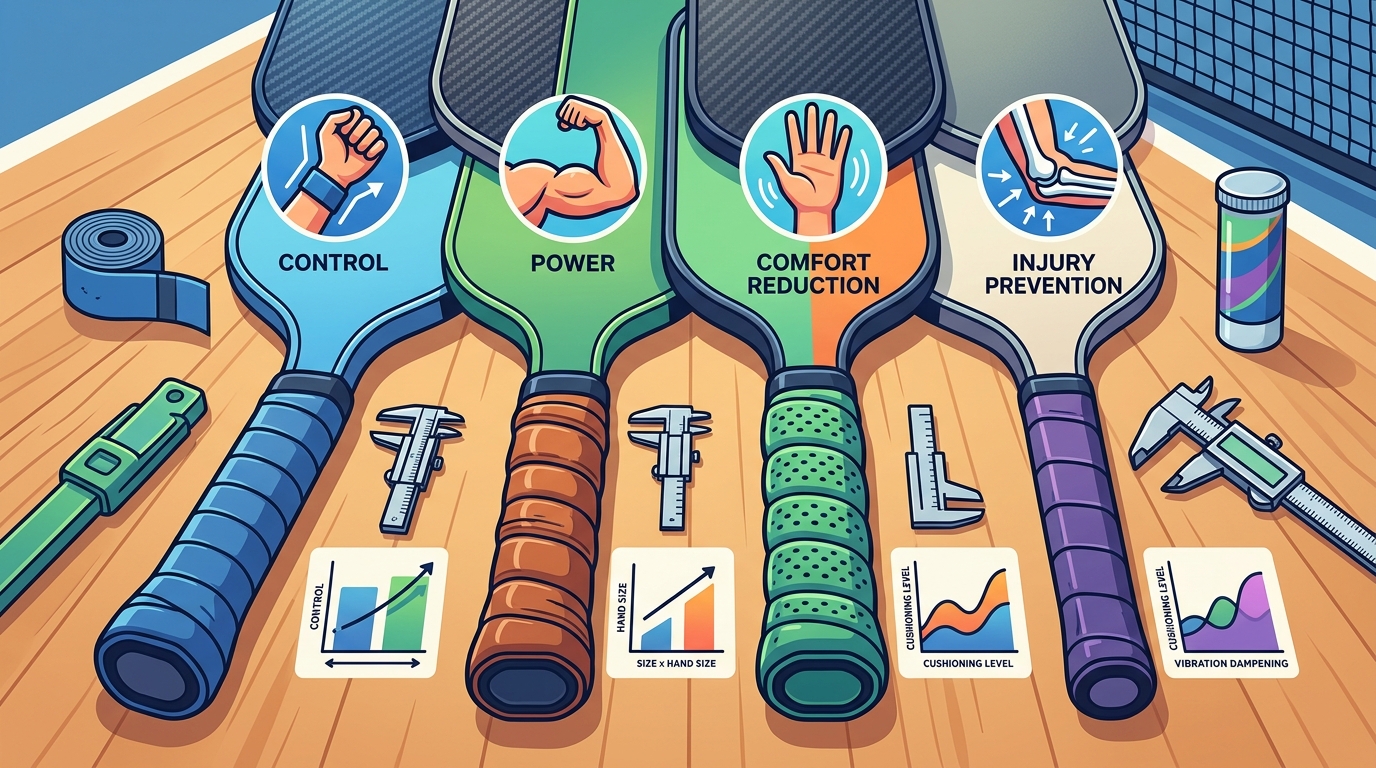
Size and Playing Style
| Player Type | Recommended Circumference | Why It Works |
|---|---|---|
| Power / Aggressive | 4.25–4.5 in. | Larger grip stabilises the wrist during hard drives and overhead smashes, aiding efficient power transfer. |
| Control / Defensive | 4.0–4.25 in. | Smaller grip allows more wrist action for spin, dinks, and angle adjustments at the kitchen line. |
| All-Around | 4.25 in. | The middle ground accommodates both touch shots and moderate drives without compromise. |
Players with hand conditions such as arthritis generally benefit from a slightly larger grip for added stability and reduced strain during extended play.
Pillar 2 — Handle Length
Handle length directly affects paddle face size, weight distribution, and shot mechanics. Because overall paddle dimensions are regulated (combined length plus width cannot exceed 24 inches), every inch added to the handle is an inch removed from the face.
Three Length Categories
- Short handles (under 5 inches): These shift weight into the paddle face, creating a larger sweet spot. They excel at quick volleys, dinks, and fast-hands exchanges at the net.
- Standard handles (5–5.25 inches): A balanced option suitable for all playing styles, offering versatility without sacrificing face size or leverage.
- Long handles (5.25+ inches): Ideal for players who use two-handed backhands, want extra leverage on serves and groundstrokes, or simply have larger hands that need the room.
Matching Handle Length to Your Game
If you camp at the kitchen line and rely on reflexes, a short handle keeps the mass high and the paddle manoeuvrable. If you play from the baseline with heavy topspin drives, a long handle gives you the leverage to generate racquet-head speed. Doubles specialists who do a bit of both usually land on a standard 5-inch handle.
Pillar 3 — Grip Surface: Replacement Grips vs. Overgrips
Your paddle arrives with a factory replacement grip (also called the base grip). This is the thicker, semi-permanent layer wrapped directly onto the bare handle. On top of that, many players add an overgrip—a thin, disposable wrap that fine-tunes feel, tackiness, and moisture management.
Replacement Grip Essentials
A replacement grip is thicker and more padded than an overgrip, typically 1.5–2.5 mm, and is installed with adhesive backing directly onto the paddle handle. It defines the bevel feel in your fingers, absorbs impact shock through EVA foam cushioning, and sets the baseline circumference. Plan to replace it every 6–12 months when the foam compresses or the surface degrades.
Overgrip Essentials
An overgrip is ultra-thin (0.4–0.7 mm) and tension-wrapped over the replacement grip with no adhesive. It adds roughly 1/16 of an inch to circumference. Overgrips fall into two broad categories:
- Tacky overgrips — Provide a sticky surface for maximum paddle security. Preferred by aggressive players who need a locked-in feel during powerful swings. Popular options include brands like Gamma Supreme (tacky feel) and similar high-tack wraps.
- Dry overgrips — Engineered to absorb sweat and actually become grippier when wet. Best for hot climates or heavy sweaters. Tourna Grip is the classic example, identifiable by its signature light-blue color.
The 1+1 Setup Most Competitive Players Use
The optimal approach for serious players is to keep a quality replacement grip on the paddle for shock absorption and wrap a fresh overgrip over it for traction. This layered system lets you swap the cheap outer layer as often as needed—every few sessions for tournament players—while preserving the more expensive base grip underneath.
Grip Material Textures Explained
Beyond the overgrip-vs-replacement distinction, the actual material texture matters:
- Rubber grips: Durable and naturally tacky, but can become slippery if your hands produce a lot of moisture.
- Cushioned (foam) grips: Softer, more shock-absorbent, and ideal for players who log long sessions or have joint sensitivity.
- Perforated grips: Feature small ventilation holes that enhance breathability and wick sweat away during intense play in warm conditions.
Experimenting with different textures is the only way to find what feels right. Two players with identical hand sizes can have completely different material preferences based on sweat level, grip pressure, and comfort expectations.
Handle Shape: The Overlooked Variable
Most pickleball paddles feature an octagonal cross-section, but subtle differences exist. A rounded grip shape works universally and accommodates continental, semi-western, or western grip styles. Players who transitioned from table tennis often prefer a squarer handle shape because it replicates the flat feel of a ping-pong paddle. If you switch grips frequently during a rally—say, from continental for a volley to semi-western for a drive—a rounder profile will feel more forgiving.
Player Archetype Quick-Reference
| Archetype | Grip Circumference | Handle Length | Overgrip Type | Key Benefit |
|---|---|---|---|---|
| Net Warrior (dinks, volleys) | 4.0–4.125 in. | Short (<5 in.) | Tacky | Maximum wrist freedom and paddle-face control |
| Baseline Banger (drives, serves) | 4.25–4.5 in. | Long (5.25+ in.) | Dry or tacky | Stability and leverage for power generation |
| Two-Handed Backhand Player | 4.0–4.25 in. | Long (5.5+ in.) | Player preference | Room for both hands; extra torque on backhands |
| All-Court Hybrid | 4.25 in. | Standard (5–5.25 in.) | Tacky | Balanced feel for switching between net and baseline |
| Sweaty-Hands Specialist | Match hand size | Any | Dry (e.g., Tourna) | Sweat absorption; grip improves when wet |
Common Grip Mistakes and How to Fix Them
- Using the factory grip forever. Stock grips lose tackiness and cushion over time, degrading performance. For competitive play, replace overgrips every 8–10 hours of court time; recreational players should swap every 20–30 hours.
- Stacking two replacement grips. Doubling up on base grips makes the handle massively thick and round, eliminating bevel feel and destroying your ability to control paddle angle for spin shots.
- Ignoring the between-sizes rule. If your hand measurement is between sizes, always go smaller. You can add an overgrip (roughly 1/16 inch) to dial in the perfect circumference, but shrinking a too-large grip is extremely difficult.
- Choosing grip size by height alone. Height can be a starting point, but hand shape, finger length, and personal preference matter more. Always use the ruler or index-finger test for precision.
- Neglecting grip maintenance. A damp microfiber cloth after each session removes sweat, salt, and oils that prematurely degrade grip material. This simple habit extends grip life significantly.
Step-by-Step: Dialling In Your Perfect Grip
- Measure. Use the ruler test to find your baseline circumference.
- Identify your style. Are you a net player, baseline driver, or all-court hybrid? Use the archetype table above to narrow your circumference and handle-length ranges.
- Assess your sweat level. Heavy sweater? Lean toward a dry overgrip. Dry hands? A tacky overgrip will give you a locked-in feel.
- Test in-store or during practice. Hold several paddles and hit real shots. Comfort should always come first, even over technical specifications.
- Fine-tune with an overgrip. Once you have the right paddle, add an overgrip to micro-adjust circumference and surface feel.
- Re-evaluate every 3–6 months. Your game evolves. A player who started at the baseline may migrate to the kitchen and benefit from dropping a handle length or trimming circumference.
Key Takeaways
- Grip circumference, handle length, and surface material are the three variables that determine how a paddle feels—and performs—in your hand.
- Power players lean toward larger circumferences (4.25–4.5 in.) and longer handles; control players favour smaller grips and shorter handles for wrist flexibility.
- Overgrips and replacement grips serve different purposes: the base grip absorbs shock, the overgrip manages moisture and tack. Use both for the best results.
- Always size down when between measurements—building up a grip is easy, but slimming one down is not.
- Dry overgrips work best for sweaty hands and hot weather; tacky overgrips suit dry-handed players and cooler conditions.
- Comfort trumps specs. If a grip feels natural and secure after 30 minutes of play, you have found your match.
Frequently Asked Questions
How do I measure my pickleball paddle grip size?
Open your dominant hand, fingers extended and together. Measure from the bottom crease of your palm to the tip of your ring finger with a ruler. That measurement in inches is your ideal grip circumference. If you land between standard sizes, go with the smaller option and add an overgrip to fine-tune the fit.
What is the difference between an overgrip and a replacement grip?
A replacement grip is the thick base layer (1.5–2.5 mm) glued directly onto the paddle handle. An overgrip is an ultra-thin wrap (0.4–0.7 mm) placed over the replacement grip. The base grip provides cushioning and shock absorption; the overgrip delivers tackiness or sweat management and is designed to be replaced frequently.
Should power players use a larger or smaller grip?
Power-oriented players benefit from a slightly larger grip—around 4.25 to 4.5 inches—because the extra circumference stabilises the wrist during aggressive swings and helps transfer energy from the body to the paddle head more efficiently.
How often should I replace my pickleball overgrip?
For tournament-level play, swap your overgrip every 8–10 hours of court time. Casual players can stretch to 20–30 hours. Replace immediately if the surface feels slick, hardened, or visibly worn.
Does handle shape matter when choosing a grip?
Yes. Rounded handles suit players who rotate between multiple grip styles (continental, semi-western, western). Square-profile handles appeal to former table-tennis players who prefer a flat reference point in their palm. Test both if possible before committing.
Can I use an overgrip without a replacement grip underneath?
Technically yes, but it is not recommended. The replacement grip smooths out imperfections in the bare handle and provides essential cushioning. Without it, you lose shock absorption and may feel uncomfortable ridges or seams during play.