
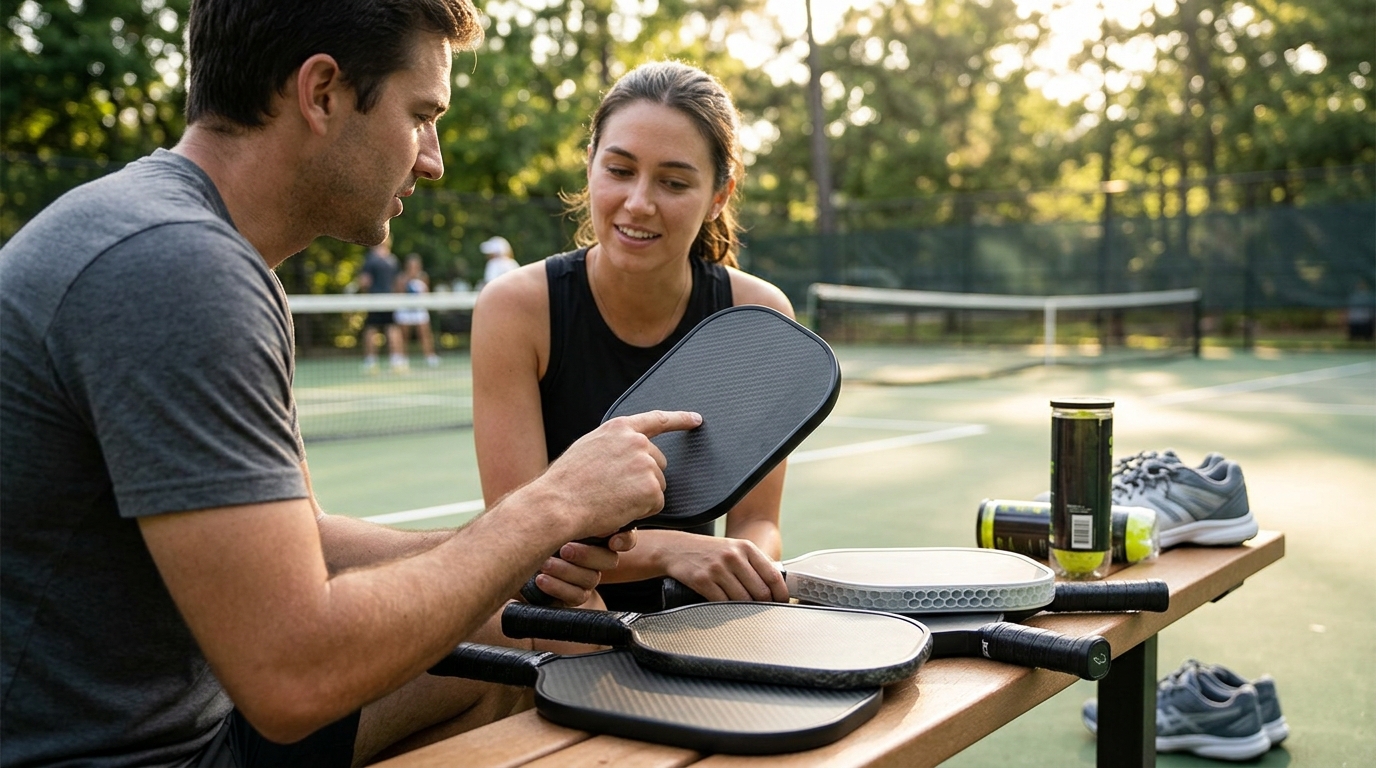
Pickleball paddles in 2026 look nothing like they did even two years ago. Foam cores, thermoformed builds, raw carbon faces, and hybrid shapes have reshaped the market so fast that spec sheets alone can leave you more confused than when you started. This comparison guide from Godfather Pickleball puts the most important paddle features next to each other—showing you exactly what you gain and what you give up with every choice—so you can walk onto the court with the right equipment for your game.
Core Material: Polymer Honeycomb vs. Foam vs. Nomex
The core is the engine room of your paddle. It sits between the two face layers and controls how the ball feels, how much power you generate, and how large your sweet spot is.
Polymer (Polypropylene) Honeycomb
Polypropylene honeycomb is the dominant core in modern pickleball. It offers a balanced blend of control, power, shock absorption, and quiet play. If you have never tried another core type, odds are every paddle you have hit with used poly.
- Power: Moderate—depends on cell size, wall thickness, and polymer density.
- Control: Excellent, especially in thicker configurations.
- Noise: Quieter than Nomex or aluminum.
- Durability: Very good for daily recreational and tournament play.
Foam Core (Full-Foam & Foam-Enhanced)
Foam cores are the biggest material shift in paddles in recent years. Full-foam designs provide more consistent energy return, less vibration, and broader sweet spots than traditional poly honeycomb. They also tend to produce a “pocketing” feel that many players describe as plush, making spin and shaping easier from the baseline.
However, foam paddles can feel very different from what you are used to, and some models have faced scrutiny around tournament compliance. Spend court time with a foam paddle before committing.
Nomex
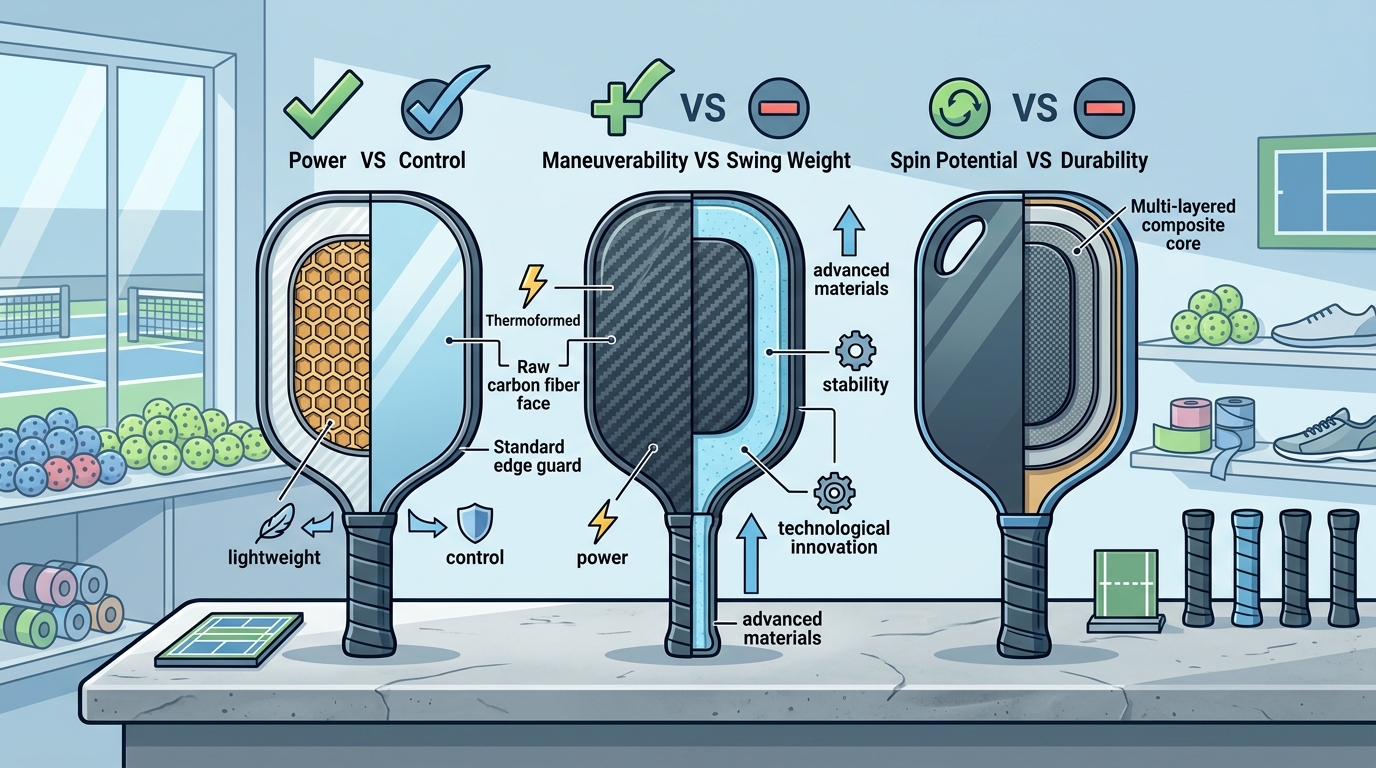
Nomex is a resin-coated, paper-like honeycomb material originally developed for aerospace applications. It is the hardest and loudest of the three core types, delivering raw power at the expense of touch and noise control. While once the standard for high-performance paddles, Nomex has been largely displaced by polymer and is now found mostly in legacy models or budget-tier offerings.
Side-by-Side Core Comparison
| Attribute | Polymer Honeycomb | Foam | Nomex |
|---|---|---|---|
| Power | Medium | Medium–High | High |
| Control | High | High | Low–Medium |
| Sweet Spot | Good | Very Good | Smaller |
| Noise Level | Low | Low | Loud |
| Market Availability | Dominant | Growing Fast | Declining |
Bottom line: For most players, a polymer honeycomb core remains the safest, most versatile choice. If you want the latest in feel and forgiveness and do not mind paying a premium, foam-enhanced or full-foam paddles are worth serious consideration.
Core Thickness: 14 mm vs. 16 mm
Core thickness might be the single quickest way to change how a paddle plays. Two common thicknesses dominate the market in 2026: 14 mm and 16 mm.
| Attribute | 14 mm (Thinner) | 16 mm (Thicker) |
|---|---|---|
| Feel | Firmer, crisper | Softer, more cushion |
| Power / Pop | More pop | Less raw pop |
| Sweet Spot | Smaller | Larger |
| Control | Requires better technique | More forgiving |
| Best For | Singles, aggressive drivers | Doubles, all-court play |
A thicker 16 mm core generally increases softness, sweet-spot size, and control, while a thinner 14 mm core delivers a firmer feel with more pop. Beginners and intermediate players typically find more success with 16 mm. Advanced players who want to finish points with speed may prefer 14 mm.
Face Material: Carbon Fiber vs. Fiberglass vs. Graphite
The face (also called the hitting surface) determines how you interact with the ball at the moment of contact. Three materials dominate:
Carbon Fiber
Carbon fiber faces are the gold standard in 2026. They are stiff, lightweight, and provide excellent energy transfer. Raw carbon fiber surfaces generate significant spin thanks to their textured finish, and brands are now engineering for texture longevity so spin performance does not drop off after a few dozen sessions.
Fiberglass (Composite)
Fiberglass faces flex more than carbon fiber on impact, which adds a “trampoline” effect that translates into power. They tend to be slightly heavier but are a popular choice for players who hit hard and want extra pop. The trade-off is somewhat less control and spin compared to carbon fiber.
Graphite
Graphite is one of the thinnest and lightest face materials available. It provides a consistent, responsive feel and is favored by finesse players. However, it produces less raw power than fiberglass and less spin texture than raw carbon fiber.
| Attribute | Carbon Fiber | Fiberglass | Graphite |
|---|---|---|---|
| Power | Medium–High | High | Medium |
| Spin | Excellent | Good | Moderate |
| Control | Excellent | Good | Very Good |
| Weight | Light | Moderate | Very Light |
| Durability | High | Medium | Medium |
Bottom line: If you want the broadest mix of spin, control, and durability, carbon fiber faces—especially raw or uncoated versions—are the way to go. Fiberglass is excellent for power-first players; graphite suits touch-oriented games.
Paddle Shape: Widebody vs. Elongated vs. Hybrid
Paddle shape affects reach, sweet-spot size, and maneuverability. In 2026, the gap between shapes has narrowed significantly thanks to engineering improvements, but each still offers distinct advantages.
- Widebody: A wider face (roughly 8” or wider) provides the largest sweet spot and the most forgiving hitting surface. This is the most popular shape among recreational and doubles players.
- Elongated: A longer, narrower paddle adds reach—ideal for singles play and two-handed backhands—but concentrates the sweet spot in a smaller area.
- Hybrid: Splits the difference between widebody and elongated, offering moderate reach without sacrificing too much sweet spot. This shape has surged in popularity because it pairs well with foam cores and delivers stability at the kitchen line.
Your choice should come down to which aspects matter most to your game. Doubles-heavy players who dink often may prefer a widebody for its forgiveness, while singles specialists and baseliners may lean toward an elongated frame for extra reach on drives and overheads.
Static Weight vs. Swing Weight: Know the Difference
Most paddle listings advertise static weight—the number on the scale, typically between 7.5 and 8.3 ounces for performance paddles. But static weight alone does not tell you how a paddle feels in motion.
Swing weight measures how heavy a paddle feels when you actually swing it. Two paddles at 8.0 oz can have very different swing weights depending on where the mass is distributed. A head-heavy paddle has a higher swing weight and generates more power on drives; a handle-heavy paddle has a lower swing weight and is quicker for reactions at the net.
Most paddle companies now publish swing weights. If yours does not, independent reviewers and databases list swing-weight data for hundreds of models. When comparing paddles, always check swing weight alongside static weight to understand the complete picture.
Surface Texture & Spin Durability
Spin is no longer just about technique; your paddle’s surface grit plays a huge role. In 2026, ultra-high-friction raw carbon and composite surfaces are engineered to maximize spin without relying on coatings that wear down quickly.
Pay attention to two things when evaluating surface texture:
- Initial grit: How much spin can you generate out of the wrapper? Raw carbon fiber surfaces typically lead here.
- Grit longevity: Does the texture hold up after 50, 100, or 200+ hours of play? This is where cheaper paddles often fall short. Look for brands that specifically address texture durability in their marketing or reviews.
If you play frequently, a paddle that maintains its spin surface over hundreds of hours will outperform a cheaper option that peaks on day one and declines steadily.
Noise Factor: Quiet Paddles & Community Play
Noise is becoming a serious purchasing factor. Many communities have imposed decibel limits or outright banned certain paddles from public courts. The rise of purpose-built quiet paddle designs—using sound-dampening materials and construction—means you no longer have to sacrifice performance for peace.
Modern quiet designs use foam or polymer cores paired with vibration-absorbing face layers that reduce the sharp “ping” at contact. If you play in a noise-sensitive area, make this one of your first filters when shopping.
Handle Length & Grip Size
Handle length affects leverage, two-handed backhand comfort, and overall swing mechanics. Standard handles sit around 5” to 5.25”, while extended handles reach 5.5” or longer. An extra-long handle is a must-have if you hit a two-handed backhand; it gives your off-hand room to grip comfortably.
Grip circumference matters for comfort and injury prevention. A grip that is too small forces you to squeeze harder, increasing fatigue and the risk of tennis elbow. Most adult players land between 4” and 4.25” circumference. When in doubt, go slightly smaller—you can always build up a grip with an overgrip, but you cannot make a too-large grip thinner.
Key Takeaways
- Core material sets the foundation. Polymer honeycomb works for the widest range of players; foam cores offer a plush, forgiving upgrade with a growing presence in 2026.
- Core thickness is a quick power-vs-control lever. Choose 16 mm for forgiveness, 14 mm for pop.
- Carbon fiber faces dominate for spin and durability. Fiberglass adds power; graphite favors finesse.
- Shape matters less than it used to, but widebody paddles still offer the biggest sweet spot and hybrid shapes are surging.
- Swing weight trumps static weight. Always check how the paddle feels in motion, not just on a scale.
- Surface grit degrades. Prioritize texture longevity if you play more than twice a week.
- Noise restrictions are real. Quiet-paddle technology has matured enough that you do not sacrifice quality for lower decibels.
- Handle length and grip size prevent injury and affect your stroke mechanics—do not overlook them.
Frequently Asked Questions
What is the best core material for a pickleball paddle?
For most players, polypropylene honeycomb remains the best all-around core material. It provides a balanced mix of control, power, and quiet play. Foam cores are an emerging alternative that offer broader sweet spots and a softer feel, making them popular among intermediate and advanced players looking for extra forgiveness.
Does core thickness really make a difference?
Yes. A thicker 16 mm core increases the sweet-spot size, adds cushion, and improves control. A thinner 14 mm core feels firmer and produces more pop, which appeals to aggressive, power-oriented players. The right choice depends on whether you prioritize consistency or explosiveness.
Carbon fiber or fiberglass face—which should I pick?
Carbon fiber is the better overall choice for most players in 2026 because it provides superior spin, control, and durability. Fiberglass delivers more raw power thanks to its flex, making it attractive for hard-hitting “banger” styles. If spin and touch are central to your game, go carbon fiber.
What paddle shape is best for doubles?
Widebody and hybrid shapes are generally preferred for doubles because they offer a larger sweet spot and better maneuverability during fast kitchen exchanges. Elongated paddles are more popular in singles where reach and driving power matter more.
Why does swing weight matter more than static weight?
Static weight tells you how heavy the paddle is on a scale, but swing weight reveals how the mass is distributed and how it feels during a stroke. Two paddles can weigh the same yet feel drastically different in play. A higher swing weight adds power on drives; a lower swing weight makes the paddle quicker for net reactions.
How do I know if a paddle is quiet enough for my courts?
Check whether the paddle uses a foam or thick polymer core and a vibration-absorbing face. Some brands specifically market “quiet” models that have been tested for reduced decibel output. Also look for community or facility guidelines that list approved paddles or decibel limits.
Where can I find pro-tested paddles that match these features?
Godfather Pickleball curates a selection of paddles tested by athletes and organized by playing style, so you can filter by core type, shape, and price to find the right fit. Browse the full collection at godfatherpickleball.com.