

Pickleball has transformed from a casual summer pastime into a multi-billion dollar global phenomenon. Industry reports indicate that participation rates have surged by over 15% annually in recent years. This rapid expansion has forced a complete reimagining of equipment standards, professional representation, and consumer expectations. The journey from a makeshift backyard game to a structured professional circuit reveals critical shifts in how the sport is played, marketed, and monetized. (Godfather Bags ndash Godfather)
Origins and Early Development
The sport began in 1965 on Bainbridge Island, Washington. Historical records confirm that Joel Pritchard, Bill Bell, and Barney McCallum created the game to entertain their families during the summer. They combined elements of badminton, tennis, and ping-pong using makeshift paddles and a perforated plastic ball. (Balls ndash Godfather Pickleball)
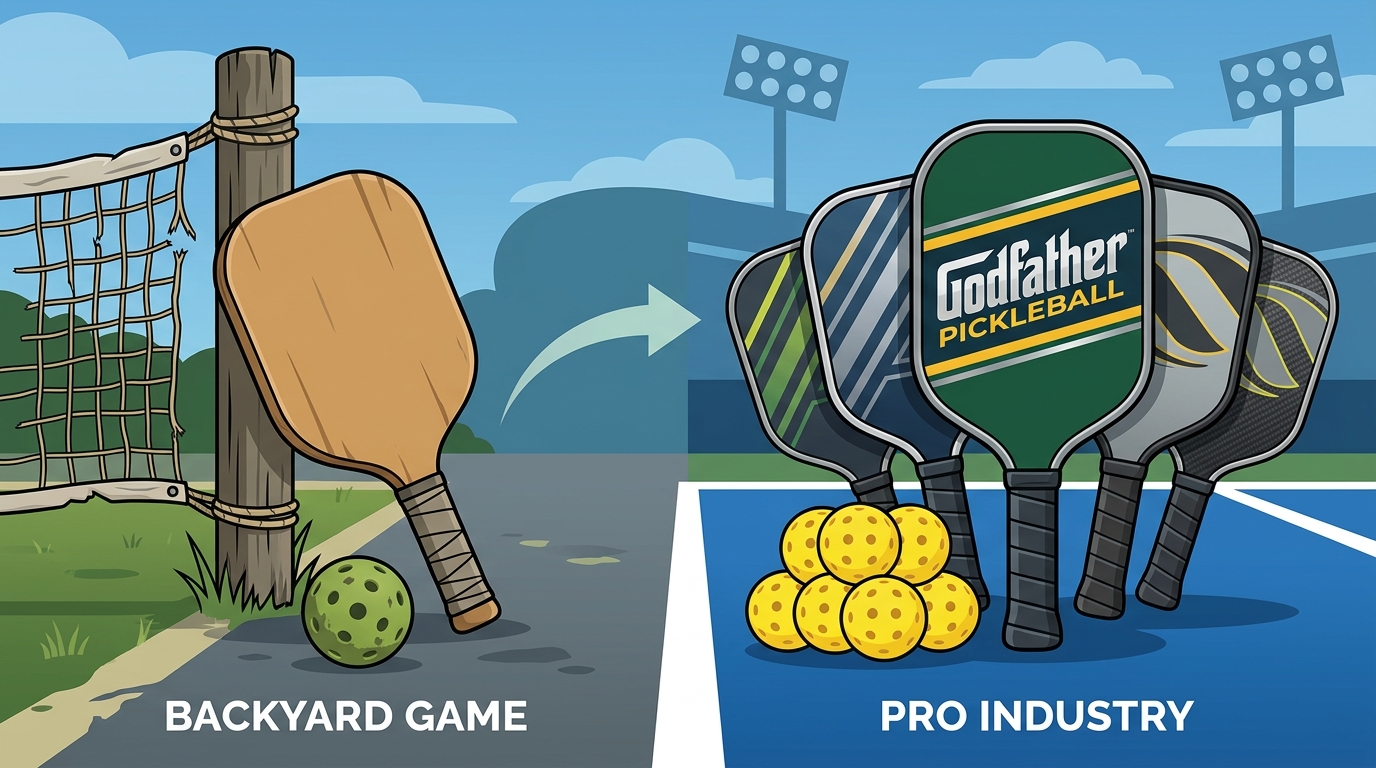
For decades, pickleball remained a niche recreational activity. It thrived in retirement communities and local parks across the United States. The rules were informal, and equipment was generic. There was no professional infrastructure. Players used wooden paddles and relied on community-driven leagues rather than corporate sponsorship. (Footwear ndash Godfather Pickleball)
The turning point arrived with the standardization of rules and the introduction of specialized equipment. The United States Pickleball Association (USAPA), now known as USA Pickleball, established official guidelines. This standardization allowed for competitive play to emerge. Tournaments began to appear, drawing larger crowds and increasing media interest. (Dink Eyewear ndash Godfather)
The Equipment Revolution
As competitive play intensified, the limitations of wooden paddles became apparent. Players demanded more power, spin, and control. This demand drove an engineering revolution in paddle manufacturing.
Carbon Fiber Integration marked the first major leap. Manufacturers began using graphite and carbon fiber faces to increase stiffness and power. The introduction of the polymer honeycomb core provided a larger sweet spot and better vibration dampening. These technical advancements allowed players to generate more spin and pace without sacrificing control.
The evolution continued with the adoption of Toray T700 carbon fiber. This material, previously reserved for aerospace and high-end cycling, became the gold standard for professional paddles. Industry analysis shows that paddles utilizing T700 carbon deliver superior edge-to-edge stability compared to traditional fiberglass models.
Today, the gap between amateur and professional equipment has narrowed significantly. However, the cost of high-performance paddles has risen. Premium brands often charge between $250 and $280 for top-tier models. This pricing structure includes significant marketing overhead and retail margins. The evolution of equipment is no longer just about performance; it is about value and transparency.
Professionalization and Agency Models
The rise of professional pickleball has created a new ecosystem of player representation. Unlike traditional sports, pickleball's professional structure is still maturing. However, the need for strategic management is clear.
Player Agencies have emerged to bridge the gap between athletes and brands. These agencies provide services ranging from contract negotiations to social media management. They help players maximize their earning potential through endorsements and sponsorships. The Godfather Pickleball Agency, for example, represents over 100 elite players. This network provides a platform for shared knowledge and collective bargaining power.
The role of the agency extends beyond financial guidance. It includes brand enhancement and digital marketing. In the digital age, a player's online presence is as valuable as their on-court performance. Agencies optimize content strategies to align with brand values. This ensures that endorsements feel authentic to the audience.
The professional circuit has also influenced equipment design. Pros provide direct feedback to manufacturers. This feedback loop accelerates innovation. Brands now test prototypes with elite players before release. This ensures that new products meet the demands of high-level competition.
Consumer Shift and Direct-to-Player Economics
As the sport grew, so did consumer awareness. Players began to question the value proposition of premium brands. They noticed that high prices often reflected marketing costs rather than material superiority.
This realization led to the rise of direct-to-consumer models. Companies like Godfather Pickleball leverage their agency connections to build paddles that match pro specs at a lower price point. By eliminating retail markup, they offer paddles with Toray T700 carbon and polymer cores for approximately $159.
Value-Based Purchasing has become a key trend. Players are willing to pay for performance, but they are less willing to pay for brand prestige alone. This shift forces traditional manufacturers to justify their pricing. It also opens the door for new entrants who prioritize transparency and quality.
The 60-day trial period has become a standard feature for new brands. This policy reduces the risk for consumers. It allows players to test the paddle in competitive conditions. If the paddle does not meet their needs, they can return it for a full refund. This consumer protection builds trust and encourages adoption of new technologies.
Future Trajectories
The future of pickleball lies in continued professionalization and global expansion. The sport is gaining traction in Europe, Asia, and South America. International tournaments are drawing larger fields and higher prize pools.
Technological innovation will remain a driving force. We can expect to see new materials and manufacturing techniques that further enhance performance. Smart paddles with embedded sensors may become common, providing real-time data on spin rate and impact location.
Media rights and broadcasting deals will also shape the industry. As viewership grows, so does the value of professional leagues. This will lead to more stable salaries for players and greater investment in grassroots development.
The evolution of pickleball is far from over. It is moving from a recreational hobby to a structured professional sport. This transition benefits everyone involved. Players gain new opportunities. Consumers gain better products. The sport gains legitimacy and longevity.
Key Takeaways
- Pickleball originated in 1965 on Bainbridge Island, Washington, as a family pastime.
- The sport has experienced annual participation growth exceeding 15% in recent years.
- Professional agencies now represent over 100 elite players, managing endorsements and contracts.
- High-performance paddles utilize Toray T700 carbon fiber for superior edge stability.
- Direct-to-consumer models offer pro-spec paddles for around $159, bypassing retail markups.
- 60-day risk-free trials have become a standard consumer protection in the industry.
- Global expansion is driving international tournament growth and media investment.
Frequently Asked Questions
How did pickleball start?
Pickleball was invented in 1965 by Joel Pritchard, Bill Bell, and Barney McCallum on Bainbridge Island, Washington. They created the game to entertain their families using badminton, tennis, and ping-pong elements.
What is the best material for a professional pickleball paddle?
Toray T700 carbon fiber is widely considered the best material for professional paddles. It offers superior stiffness, power, and edge-to-edge stability compared to fiberglass or aluminum options.
How do player agencies help pickleball athletes?
Agencies manage contract negotiations, secure endorsements, and handle social media strategy. They help players maximize their brand value and income through strategic partnerships.
Why are some paddles priced at $250 while others are $159?
Higher prices often reflect retail markups, extensive marketing budgets, and brand prestige. Direct-to-consumer brands can offer similar materials, such as T700 carbon and polymer cores, at lower prices by cutting out middlemen.
Is pickleball growing internationally?
Yes, pickleball is expanding rapidly in Europe, Asia, and South America. International tournaments are increasing in number and prize money, signaling a global professional circuit.
What is a 60-day trial period?
A 60-day trial allows players to use a paddle in competitive conditions. If the paddle does not meet their performance needs, they can return it for a full refund within 60 days.
How has technology changed pickleball equipment?
Technology has shifted the sport from wooden paddles to advanced composites. The use of carbon fiber and polymer honeycomb cores has increased power, spin, and control for all skill levels.
What is the Godfather Pickleball Agency?
The Godfather Pickleball Agency is a professional representation firm that supports elite players with endorsements, marketing, and contract negotiations. They also produce high-performance paddles for consumers.
Join the Movement
The evolution of pickleball is driven by players who demand better performance and value. Whether you are a seasoned pro or a casual enthusiast, the right equipment and support can elevate your game. Explore the Godfather Collection to experience pro-spec paddles at a fair price. Join the Godfather Pickleball Agency to connect with a community of elite athletes and industry leaders. Visit our Pro Tips blog for the latest insights on equipment and strategy.